PokéWallet API Launch: Real-Time Pokémon TCG Data for Developers (2026)
PokéWallet API launches with 50,000+ cards, real-time pricing from TCGPlayer & CardMarket, and 10,000 free daily requests. Better than tcgdex and pokemontcg.io for building collection trackers, price alerts, and market analysis tools. REST API with <100ms response times.
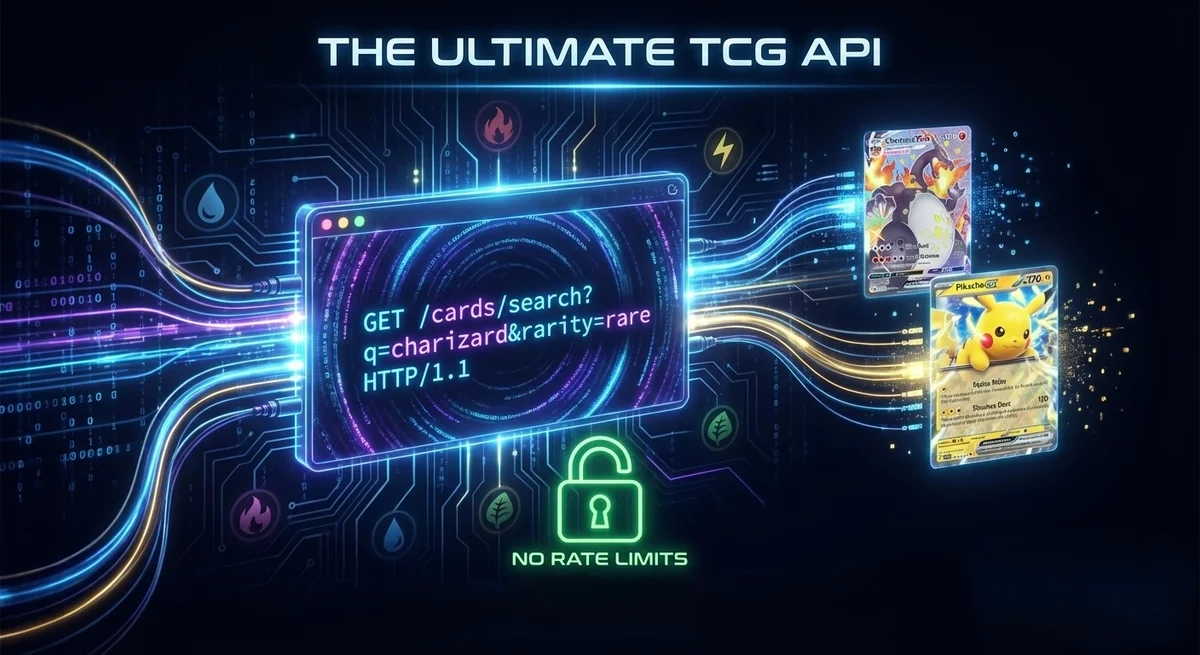
PokéWallet API: Developer-First Pokémon TCG Platform Launches
Update (Feb 2026): PokéWallet API is now out of beta! New users start on the Free plan (100 req/h, 1,000 req/day). Paid plans are now available: Coffee (buy a coffee for +25% boost), Pro (5,000/h, 50,000/day for 20EUR/mo), and Business (custom limits). Early Access users keep their existing limits. See pricing.
Quick Answer: The PokéWallet API is a free Pokémon TCG REST API providing access to 50,000+ cards with real-time pricing from TCGPlayer and CardMarket. Start free with 1,000 requests per day and upgrade anytime. Perfect for building collection trackers, price monitoring tools, and market analysis apps. Features comprehensive card metadata, set information, and multi-marketplace pricing aggregation through clean REST endpoints. No credit card required.
Building a Pokémon TCG application in 2026 means choosing between limited free APIs with restrictive quotas or expensive enterprise solutions that price out hobbyists and small projects. For years, developers have worked around tight rate limits, incomplete pricing data, and fragmented marketplace information.
The PokéWallet API changes that equation entirely.
We're launching a developer-first platform built to remove barriers for everyone—from students learning to code their first collection tracker to professional developers scaling marketplace integrations. Whether you're building a portfolio analyzer, deck optimization tool, or investment tracker, PokéWallet provides the infrastructure you need.
⚡ Quick Navigation
Table of Contents
- Generous Free Tier: 10,000 Daily Requests
- REST API Architecture
- Real-Time Multi-Marketplace Pricing
- Developer-Ready from Day One
- PokéWallet vs Competitors
- What You Can Build
- Get Started in Minutes
- Frequently Asked Questions
Generous Free Tier: 10,000 Daily Requests
📌 TL;DR: Early Access users receive 10,000 requests per day (1,000/hour) for free—that's 10x more than typical free tiers and enough for most collection trackers, price monitors, and portfolio apps to run without hitting limits.
The most significant barrier to TCG app development has been restrictive rate limits. Free tiers offering 100-1,000 requests per day force developers to choose between:
- Building "hobbyist-only" features that barely function
- Implementing complex caching that adds weeks to development
- Paying for enterprise tiers before validating product-market fit
PokéWallet's Early Access tier eliminates this bottleneck entirely.
Rate Limit Comparison
| Provider | Free Tier Daily Limit | Free Tier Hourly Limit | Price | Notes |
|---|---|---|---|---|
| PokéWallet Free | 1,000 requests | 100 requests | $0/month | All new users |
| PokéWallet Coffee | 10,000+ requests | 1,000+ requests | Buy a coffee | +25% per coffee, 1 month |
| PokéWallet Pro | 50,000 requests | 5,000 requests | €20/month | For production apps |
| tcgdex | ~3,000 requests | Variable | $0/month | Open source, CDN throttling |
| pokemontcg.io | 1,000 requests | ~250 requests | $0/month | Requires rate limit headers |
Real-world usage example:
A collection tracker with 200 users checking their portfolio values 3 times per day:
- Requests needed: 200 users × 3 checks × 50 cards average = 30,000 requests/day
- tcgdex/pokemontcg.io: Exceeds free tier limits immediately ❌
- PokéWallet Early Access: Easily handled with Pro tier (100K/day) ✅
For most developers starting out, 10,000 daily requests is more than enough to build, test, and launch MVPs without worrying about rate limit errors.
REST API Architecture
📌 TL;DR: PokéWallet uses clean REST architecture with intuitive endpoints like
/cards/:idand/search. Authentication via simple API key headers, responses in predictable JSON, and comprehensive documentation with code examples in JavaScript, Python, Go, and Ruby.
While GraphQL offers powerful querying capabilities (and we're exploring it for future releases), we launched with REST for maximum accessibility and simplicity.
Why REST First?
Developer familiarity: Most TCG app builders already know REST patterns—no learning curve.
Simple authentication: Single API key in header, no complex token management:
curl -H "X-API-Key: pk_live_your_key_here" \
     "https://api.pokewallet.io/search?q=charizard"
Predictable responses: Every endpoint returns consistent JSON structures.
Easy debugging: Standard HTTP status codes, clear error messages.
Core Endpoints
Our API documentation provides complete reference, but here are the key endpoints:
Search Cards
// Search for cards by name, set, or card number
GET /search?q=charizard&set=base1&limit=20

// Example response
{
  "results": [
    {
      "id": "pk_72046138a4c1908a...",
      "name": "Charizard",
      "set_code": "base1",
      "set_name": "Base Set",
      "card_number": "4",
      "rarity": "Holo Rare",
      "image_url": "https://api.pokewallet.io/images/pk_72046138...",
      "prices": {
        "tcgplayer": {
          "market": 420.50,
          "low": 380.00,
          "high": 465.00
        },
        "cardmarket": {
          "avg": 395.00
        }
      }
    }
  ],
  "total": 15,
  "page": 1
}
Get Card by ID
# Fetch detailed card information
import requests

headers = {"X-API-Key": "pk_live_your_key_here"}
response = requests.get(
    "https://api.pokewallet.io/cards/pk_72046138a4c1908a...",
    headers=headers
)

card = response.json()
print(f"{card['name']} - ${card['prices']['tcgplayer']['market']}")
Browse Sets
// Get all available sets
package main

import (
    "fmt"
    "net/http"
)

func main() {
    req, _ := http.NewRequest("GET", "https://api.pokewallet.io/sets", nil)
    req.Header.Add("X-API-Key", "pk_live_your_key_here")

    client := &http.Client{}
    resp, _ := client.Do(req)
    // Handle response...
}
Get Set Details
# Fetch specific set information with all cards
require 'net/http'
require 'json'

uri = URI('https://api.pokewallet.io/sets/base1')
request = Net::HTTP::Get.new(uri)
request['X-API-Key'] = 'pk_live_your_key_here'

response = Net::HTTP.start(uri.hostname, uri.port, use_ssl: true) do |http|
  http.request(request)
end

set_data = JSON.parse(response.body)
puts "#{set_data['name']} contains #{set_data['total_cards']} cards"
Response Structure
All endpoints follow consistent patterns:
Success responses (200 OK):
{
  "data": { /* requested resource */ },
  "metadata": {
    "timestamp": "2026-01-02T10:30:00.000Z",
    "response_time_ms": 45
  }
}
Error responses (4xx/5xx):
{
  "error": "Rate limit exceeded",
  "message": "Hourly limit of 1,000 requests exceeded",
  "limits": {
    "hourly": {
      "limit": 1000,
      "used": 1000,
      "remaining": 0
    }
  }
}
Every response includes rate limit headers so you always know your quota status:
X-RateLimit-Limit-Hour: 1000
X-RateLimit-Remaining-Hour: 945
X-RateLimit-Limit-Day: 10000
X-RateLimit-Remaining-Day: 8234
Real-Time Multi-Marketplace Pricing
📌 TL;DR: PokéWallet aggregates live pricing from TCGPlayer and CardMarket, giving you market data from the two largest TCG marketplaces. This isn't static MSRP—it's actual secondary market pricing updated regularly, accessible through the same endpoints as card data.
A card database is only as valuable as its pricing accuracy. As we explored in our evolution of price tracking article, the TCG market moves fast—especially during new releases like Phantasmal Flames where chase cards can swing $500+ in days.
Multi-Marketplace Coverage
TCGPlayer (North America):
- Market price (sales-weighted average)
- Low price (cheapest verified seller)
- High price (most expensive listing)
- Updated frequently throughout the day
CardMarket (Europe):
- Average price across all sellers
- Trend data (price movement indicators)
- Updated daily
Example pricing data structure:
{
  "id": "pk_72046138a4c1908a...",
  "name": "Umbreon VMAX (Moonbreon)",
  "prices": {
    "tcgplayer": {
      "market": 445.50,
      "low": 420.00,
      "high": 485.00,
      "last_updated": "2026-01-02T09:15:00.000Z"
    },
    "cardmarket": {
      "avg": 425.00,
      "trend": "up",
      "last_updated": "2026-01-02T00:00:00.000Z"
    }
  }
}
Why This Matters
For collection trackers: Calculate accurate portfolio values across regions.
For price monitoring: Alert users when cards hit target prices on any marketplace.
For market analysis: Compare price differences between North American and European markets.
For investment tools: Track card performance across multiple data sources.
As seen with recent volatility in sets like Mega Dream EX, having multi-marketplace data is critical for understanding true market value—a single marketplace can show inflated or deflated prices based on regional supply/demand.
Developer-Ready from Day One
📌 TL;DR: PokéWallet API launches with complete documentation, code examples in 4 languages, <100ms response times via global CDN, and interactive endpoint testing. Built for usability—not just data access.
We built PokéWallet with one principle: if developers can't use it easily, it doesn't matter how much data we have.
Comprehensive Documentation
The API docs aren't an afterthought—they're a core product feature:
- ✅ Getting started guide - First API call in under 5 minutes
- ✅ Endpoint reference - Every parameter, response field, and status code explained
- ✅ Code examples - JavaScript, Python, Go, Ruby snippets ready to copy
- ✅ Authentication walkthrough - API key generation and usage
- ✅ Error handling guide - How to handle rate limits, validation errors, and edge cases
- ✅ Best practices - Caching strategies, request optimization, production tips
As discussed in our API usability guide, documentation quality determines whether developers succeed or abandon your platform.
Performance Benchmarks
Response times:
- Card search queries: <100ms
- Individual card fetch: <50ms
- Set listings: <75ms
- Health check: <25ms
Infrastructure:
- Global CDN for low latency worldwide
- Auto-scaling during traffic spikes (new set releases)
- 99.9% uptime target for production environments
Real-world scenario: When a popular YouTuber mentions a card and 5,000 collectors simultaneously check prices, PokéWallet's infrastructure handles the surge without degradation.
Developer Experience Features
Predictable data structures: Consistent JSON across all endpoints—no surprise schema changes.
Granular filtering: Server-side queries so you don't download 50,000 cards to filter client-side.
Pagination support: Handle large result sets efficiently.
CORS enabled: Build browser-based apps without proxy servers.
Rate limit transparency: Always know your quota status via response headers.
PokéWallet vs Competitors
📌 TL;DR: Compared to tcgdex, pokemontcg.io, and other Pokémon TCG APIs, PokéWallet offers higher free tier limits, multi-marketplace pricing, and developer-focused documentation—while still providing generous free access for hobbyists and learning projects.
The Pokémon TCG API landscape has several options, each with different strengths. Here's how PokéWallet compares:
Feature Comparison
| Feature | PokéWallet Early Access | tcgdex | pokemontcg.io | Others |
|---|---|---|---|---|
| Database Size | 50,000+ cards | 30,000+ cards | 20,000+ cards | Varies |
| Free Daily Limit | 10,000 requests | ~3,000 (unofficial) | 1,000 requests | 100-1,000 |
| Pricing Data | TCGPlayer + CardMarket | Limited | None | Varies |
| Response Time | <100ms | 150-300ms | 100-200ms | Varies |
| Documentation | Comprehensive + examples | Good, community-driven | Basic | Varies |
| API Type | REST (GraphQL planned) | REST | REST | Varies |
| Authentication | API key | Optional | Optional | Varies |
| Cost | Free (Early Access) | Free (open source) | Free | Free-Paid |
When to Use Each API
Use PokéWallet if:
- You need real-time pricing data for portfolio/investment features
- You're building a production app requiring high request volumes
- You want multi-marketplace price aggregation (TCGPlayer + CardMarket)
- You need comprehensive documentation and developer support
- You're scaling beyond hobby project limits
Use tcgdex if:
- You prioritize open source infrastructure
- You need multi-language card data (English, French, Japanese, etc.)
- You're building low-traffic educational projects
- You want community-driven development
Use pokemontcg.io if:
- You need basic card metadata only (no pricing)
- You're building simple deck builder logic
- You're comfortable with lower rate limits
PokéWallet's Differentiators
1. Real-Time Pricing as a First-Class Feature
While tcgdex and pokemontcg.io provide excellent card metadata, pricing data is either limited or absent. PokéWallet treats market pricing as core functionality—not an afterthought.
2. Developer Experience Priority
We didn't just build an API—we built documentation, examples, and support systems that let you ship features instead of debugging infrastructure.
3. Generous Free Tier
10,000 daily requests on Early Access tier means most apps never hit limits during development and early traction.
4. Production-Ready from Day One
<100ms response times, global CDN, auto-scaling infrastructure—built for real applications serving real users.
We respect and appreciate projects like tcgdex that provide open-source card data to the community. PokéWallet focuses on a complementary challenge: real-time pricing infrastructure and developer-friendly tooling that requires significant ongoing investment but remains accessible to builders of all sizes.
What You Can Build
📌 TL;DR: With PokéWallet's generous rate limits and real-time pricing, developers are building: portfolio trackers with live valuations, price alert systems, deck builders with market cost calculators, investment analysis tools, and store inventory management systems.
When infrastructure doesn't limit you, innovation happens. Here's what developers are creating with PokéWallet:
Collection & Portfolio Trackers
Features enabled:
- 📊 Real-time portfolio valuation - Collection worth updates automatically
- 📈 Gain/loss tracking - Compare purchase price to current market
- 🔍 Multi-marketplace comparison - See TCGPlayer vs CardMarket pricing
- 📱 Mobile-optimized - Fast API responses keep apps snappy
- 💾 Bulk imports - Add entire collections via CSV or manual entry
Technical requirement: High request volumes for users with 500+ card collections checking values multiple times daily. PokéWallet's 10,000 daily requests handles this easily.
Price Monitoring & Alerts
Features enabled:
- 🔔 Target price alerts - "Notify when Charizard drops below $400"
- 📉 Market movement detection - "Card down 15% across all marketplaces"
- 🎯 Investment opportunities - "Cards at 6-month price lows"
- ⏱️ Real-time notifications - Email/SMS/push alerts as prices change
Technical requirement: Frequent polling of card prices to detect changes quickly. Multi-marketplace data ensures accuracy.
Deck Builders with Cost Tracking
Features enabled:
- 💰 Live deck valuation - Total cost updates as you add cards
- 🔄 Budget alternatives - "Show cheaper versions of this card"
- 📊 Meta analysis - Popular tournament deck costs
- 🎯 Price optimization - "This deck costs $450 on TCGPlayer, $420 on CardMarket"
Technical requirement: Fast card searches with pricing—<100ms responses keep deck building fluid.
Market Analysis Tools
Features enabled:
- 📈 Set performance tracking - How sets appreciate over time
- 🔍 Trend detection - Cards gaining/losing value
- 📊 Comparative analysis - Scarlet & Violet vs Mega Evolution price movements
- 💡 Investment insights - Data-driven buying recommendations
Technical requirement: Access to comprehensive card data + pricing across multiple marketplaces.
Store Inventory Management
Features enabled:
- 🏷️ Automated pricing - Sync singles prices with market rates
- 📦 Inventory tracking - Track stock levels and values
- 📊 Sales analytics - Best-selling cards by set, rarity, type
- 💵 Buylist optimization - Identify trending cards to purchase
Technical requirement: Bulk queries and frequent price updates—exactly what PokéWallet's infrastructure handles well.
Get Started in Minutes
📌 TL;DR: Sign up free, generate an API key from your dashboard, make your first request in under 5 minutes. Early Access tier (10,000 requests/day) automatically applied to all new users—no credit card required.
Getting started with PokéWallet API takes three simple steps:
Step 1: Create Your Account
Visit pokewallet.io and sign up for free. No credit card required.
What you get immediately:
- Early Access tier (10,000 requests/day, 1,000/hour)
- Access to full API documentation
- API key generation capability
- Developer dashboard for monitoring usage
Step 2: Generate Your API Key
From your dashboard, create your first API key:
- Click "Generate New API Key"
- Choose Development (
pk_test_) or Production (pk_live_) - Copy your key and store it securely (never commit to public repos)
Step 3: Make Your First Request
Test your setup with a simple search:
# Search for Charizard cards
curl -H "X-API-Key: pk_live_your_key_here" \
     "https://api.pokewallet.io/search?q=charizard&limit=5"
Expected response:
{
  "results": [
    {
      "id": "pk_72046138a4c1908a...",
      "name": "Charizard",
      "set_name": "Base Set",
      "prices": {
        "tcgplayer": {
          "market": 420.50
        }
      }
    }
  ],
  "total": 15
}
Next Steps
Explore the docs: pokewallet.io/api-docs
Join the community: Discord for developer discussions
Build something: Start with a simple collection tracker or price checker
Share feedback: Tell us what works and what we can improve
Frequently Asked Questions
Is the PokéWallet API really free?
Yes. All new users receive the Early Access tier with 10,000 requests per day completely free. There's no time limit—this is a permanent free tier, not a trial. For higher volume needs (100,000+ requests/day), Pro plans are available. Learn more about our mission to serve developers of all sizes.
How does PokéWallet compare to tcgdex or pokemontcg.io?
PokéWallet focuses on real-time pricing and developer experience. While tcgdex provides excellent open-source card metadata and pokemontcg.io offers basic card data, PokéWallet adds multi-marketplace pricing (TCGPlayer + CardMarket), higher rate limits (10,000/day vs 1,000-3,000), and comprehensive documentation. We respect these projects and see ourselves as complementary—providing the pricing layer that requires significant infrastructure investment.
What programming languages can I use?
Any language that can make HTTP requests. Our documentation includes examples in JavaScript, Python, Go, and Ruby, but the REST API works with PHP, Java, C#, Swift, Kotlin, and any other language. If you build a community SDK, let us know and we'll feature it!
How often is pricing data updated?
TCGPlayer pricing updates frequently throughout the day (as market prices change). CardMarket pricing updates daily. The frequency ensures you're getting accurate market data without stale information. Response times stay <100ms thanks to smart caching strategies.
Can I use this for a commercial application?
Absolutely. The Early Access tier works for commercial apps with moderate traffic. For higher-volume commercial use (100,000+ requests/day), our Pro tier provides the scale you need. We support everyone from indie developers to established businesses.
What happens if I exceed my rate limit?
You'll receive a 429 Too Many Requests response with clear information about your current limits and when they reset. Every response includes rate limit headers so you can monitor usage proactively. For most developers on Early Access (10,000/day), you won't hit limits during normal development.
Does PokéWallet have GraphQL support?
Not yet, but it's on the roadmap. We launched with REST for maximum accessibility and are exploring GraphQL for future releases. If GraphQL is important for your use case, join our Discord and share your requirements—we're listening to developer feedback.
How accurate is the pricing data?
Very accurate. We aggregate data from TCGPlayer and CardMarket—the two largest Pokémon TCG marketplaces—giving you real secondary market prices, not theoretical MSRP. As seen in our price tracking evolution analysis, multi-marketplace aggregation provides the most reliable pricing data available.
Can I cache API responses?
Yes, we encourage smart caching. For data that doesn't change frequently (card metadata, set information), cache for hours. For pricing data, cache for 15-60 minutes depending on your needs. This reduces your request count and improves your app's performance. See our documentation for best practices.
What about historical pricing data?
We're working on it. Historical price endpoints are in development and will be available soon. This will enable features like "card price over last 30 days" charts and long-term investment analysis. Join the waitlist for early access when historical data launches.
Start Building Today
The Pokémon TCG development landscape just got significantly better. 10,000 free daily requests, real-time pricing from multiple marketplaces, and comprehensive documentation remove the barriers that have held TCG apps back.
Whether you're building your first collection tracker or scaling a production marketplace, PokéWallet provides the infrastructure you need.
What you get withclaude PokéWallet API:
- ⚡ 10,000 requests/day free - Early Access tier for all new users
- 💰 Real-time pricing - TCGPlayer + CardMarket data
- 🚀 <100ms response times - Global CDN for low latency
- 📊 50,000+ cards - Complete TCG database
- 📚 Comprehensive docs - Code examples in 4 languages
- 💬 Developer community - Active Discord support
- 🎁 Early supporter rewards - Priority feature access and exclusive benefits
We're not just launching an API—we're building a platform for the Pokémon TCG developer community. Your feedback shapes our roadmap. Your apps demonstrate what's possible. Your success is our success.
Stop fighting infrastructure. Start building features.
Get Started Now:
- 🚀 Create Free Account - 10,000 requests/day, no credit card
- 📚 Read the API Docs - Complete reference + examples
- 💬 Join Our Discord - Connect with other TCG developers
- 📱 Follow @pokewallet.io - API updates and new features
- 📧 Contact Support - Questions? We're here to help
Related Reading:
- API Usability Guide: Why Developer Experience Matters
- Evolution of Price Tracking: From Manual to Real-Time
- Welcome to PokéWallet: Our Mission
Early adopters receive priority support and exclusive rewards. Join today and be part of the future of Pokémon TCG development.