PSA Power Rankings: Top 25 Most Graded Pokémon of All Time (GemRate Data 2026)
GemRate data reveals the 25 most PSA-graded Pokémon ever. Pikachu leads with 2.47M cards, Charizard at 2.34M. Complete rankings, Eeveelution dominance analysis, and market liquidity insights.
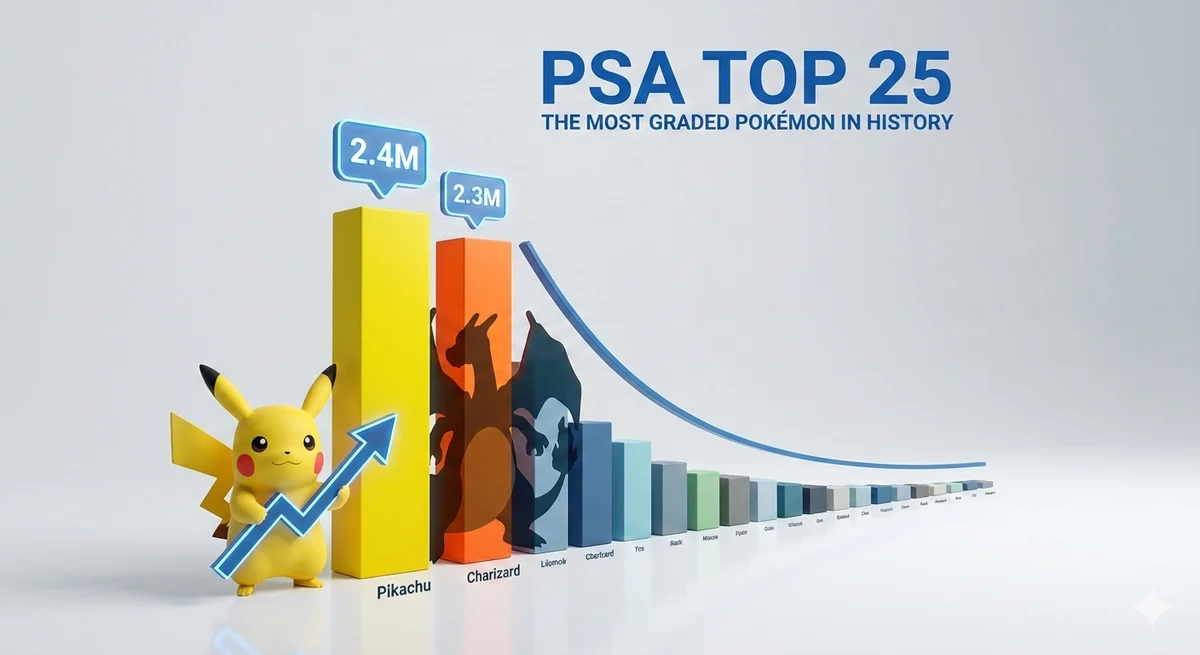
The PSA Power Rankings: Top 25 Most Graded Pokémon of All Time
📅 Last Updated: January 16, 2026
📊 Data Source: GemRate PSA Population Reports
✓ Data Accuracy: All grading counts reflect cumulative PSA submissions through Q1 2026
Quick Answer: Pikachu (~2,468,834) and Charizard (~2,340,040) are the only Pokémon to surpass 2 million PSA-graded cards—each individually exceeding the next three Pokémon combined. GemRate data confirms these two dominate market liquidity by a staggering margin, with Mew at #3 holding just 661K cards. The "Eevee Tax" is measurable: Umbreon ranks #5, beating Blastoise and Venusaur.
When we talk about "market liquidity" in the Pokémon TCG, we're usually guessing—but thanks to GemRate data, we now have a definitive leaderboard of the most graded Pokémon in PSA history. This list reveals exactly which characters collectors are willing to pay to preserve, and the gap between the top two and the rest of the field is absolutely staggering. Pikachu and Charizard exist in a completely separate tier, each surpassing 2 million graded cards while the third-place Mew sits at just 661K. For investors and collectors, understanding grading population directly correlates to market liquidity—cards with higher graded populations sell faster, have more price data points, and carry less transaction friction. This comprehensive ranking exposes surprising insights: Umbreon's dominance over original starters, the complete Eeveelution takeover of mid-tier rankings, and Rayquaza's unexpected victory over Lugia despite the latter's expensive "grail" status.
Key Takeaways
- 🏆 The Big Two Dominate: Pikachu (2.47M) and Charizard (2.34M) are the only Pokémon above 2 million graded cards
- 📉 Massive Gap to #3: Mew at 661K has less than 27% of Pikachu's graded volume
- 🌙 Umbreon Surprise: Ranks #5 with 526K, beating Blastoise (#7) and Venusaur (#8)—the "Eevee Tax" is real
- ⚡ Eeveelution Dominance: All 8 Eeveelutions rank in top 25, with 7 of 8 above Squirtle and Bulbasaur
- 🐉 Rayquaza vs Lugia: Rayquaza (#11, 293K) significantly outpaces Lugia (#16, 219K) despite Lugia's grail status
- 📊 Gen 1 Still Rules: 15 of top 25 are Gen 1 Pokémon, proving vintage appeal endures
- 💰 Liquidity = Safety: High graded volume correlates to faster sales and more stable pricing
⚡ Quick Navigation
Table of Contents
- The Big Two: A League of Their Own
- The Legendary Tier (Rank 3-10)
- The Fan Favorites (Rank 11-25)
- Market Implications: What This Means for Collectors
- Frequently Asked Questions
The Big Two: a league of their own
📌 TL;DR: Pikachu (2.47M) and Charizard (2.34M) are the only Pokémon to break 2 million graded cards. Each individually exceeds the next three Pokémon combined. This dominance comes from decades as the franchise "face" (Pikachu) and "chase" (Charizard).
The data reveals a massive chasm between the top two mascots and every other Pokémon in existence. This isn't a slight lead—it's complete domination.
The Definitive Top 2
| Rank | Pokémon | Graded Cards | % of Total Top 25 |
|---|---|---|---|
| 🥇 1 | Pikachu | ~2,468,834 | 19.8% |
| 🥈 2 | Charizard | ~2,340,040 | 18.8% |
Why the gap is staggering: Pikachu and Charizard each individually have more graded cards than positions #3 through #5 combined (Mew + Mewtwo + Umbreon = 1.78M). The third-place Mew at 661K represents just 26.8% of Pikachu's volume.
The "Face" vs "Chase" Dynamic
Pikachu's dominance comes from being the literal face of Pokémon for nearly three decades. Every promotional product, every anime episode, every merchandise category features Pikachu prominently. This translates to thousands of unique Pikachu cards across every set, era, and region—all feeding into the grading pipeline.
Charizard's position reflects its status as the ultimate "chase card" since 1999. While Pikachu appears on more total cards, Charizard cards command higher individual values, driving collectors to grade aggressively. The Charizard 1st Edition Shadowless PSA 10 reaching $420,000 exemplifies why collectors prioritize grading their Charizard pulls.
Investment Implication
If you're investing in Pokémon cards for liquidity and safety, Pikachu and Charizard represent the most liquid assets in the hobby. High graded population means more comparable sales data, faster transaction times, and more predictable pricing. These are the "blue chip" Pokémon.
The Legendary Tier (Rank 3-10)
📌 TL;DR: After the Big Two, numbers drop dramatically but competition remains fierce. Umbreon (#5) beating Blastoise (#7) and Venusaur (#8) proves the "Eevee Tax" is real and measurable. Zapdos (#9) edges out Gengar (#10)—likely due to vintage Fossil submissions.
After the Big Two, graded populations drop significantly, but this tier still represents the most actively collected Pokémon outside the elite duo.
Complete Legendary Tier Rankings
| Rank | Pokémon | Graded Cards | Gap to #2 | Notable |
|---|---|---|---|---|
| 3 | Mew | 661,606 | -71.7% | Top Mythic |
| 4 | Mewtwo | 592,782 | -74.7% | Movie icon |
| 5 | Umbreon | 526,682 | -77.5% | Highest non-Gen 1 |
| 6 | Eevee | 459,007 | -80.4% | Evolution base |
| 7 | Blastoise | 430,144 | -81.6% | Original starter |
| 8 | Venusaur | 383,953 | -83.6% | Original starter |
| 9 | Zapdos | 341,395 | -85.4% | Legendary bird |
| 10 | Gengar | 339,935 | -85.5% | Ghost icon |
The Umbreon Phenomenon
Umbreon at #5 is the biggest surprise in this data. As a Gen 2 Pokémon, it beats not only Blastoise and Venusaur (two original starters with 25+ years of card releases), but also positions itself as the highest-ranking non-Gen 1, non-Mythic Pokémon.
This proves the "Eevee Tax" is real and measurable. Collectors pay premium prices for Eeveelutions across all rarities, driving aggressive grading behavior. Umbreon's dark aesthetic and competitive viability in various TCG formats make it particularly desirable.
Zapdos vs Gengar: The Vintage Factor
Zapdos (#9) beating Gengar (#10) surprises many modern collectors who see Gengar dominating current set hype. The explanation lies in vintage submission patterns.
Zapdos appeared in Base Set, Jungle, and Fossil—the three most heavily opened sets during the 1999-2000 boom. Millions of Zapdos cards exist from this era, and the grading surge of 2020-2021 saw massive vintage submissions. Gengar's popularity is more recent, driven by modern chase cards like the Gengar Illustration Rare from Phantasmal Flames and contemporary alternate arts.
The Fan Favorites (Rank 11-25)
📌 TL;DR: Eeveelutions dominate mid-tier rankings with all 8 appearing in top 25. Rayquaza (#11) significantly outpaces Lugia (#16) despite Lugia's "grail" status. Squirtle and Bulbasaur rank below every Eeveelution except Jolteon.
The remaining positions showcase a mix of Eeveelutions, starters, and iconic dragons—with some surprising hierarchies.
Complete Fan Favorites Rankings
| Rank | Pokémon | Graded Cards | Category |
|---|---|---|---|
| 11 | Rayquaza | 293,699 | Legendary Dragon |
| 12 | Charmander | 278,567 | Starter Evolution |
| 13 | Sylveon | 265,189 | Eeveelution |
| 14 | Espeon | 241,666 | Eeveelution |
| 15 | Gyarados | 222,085 | Gen 1 Icon |
| 16 | Lugia | 219,174 | Legendary |
| 17 | Flareon | 212,933 | Eeveelution |
| 18 | Snorlax | 209,577 | Gen 1 Icon |
| 19 | Dragonite | 205,784 | Pseudo-Legendary |
| 20 | Leafeon | 205,459 | Eeveelution |
| 21 | Vaporeon | 203,335 | Eeveelution |
| 22 | Glaceon | 201,514 | Eeveelution |
| 23 | Jolteon | 198,168 | Eeveelution |
| 24 | Squirtle | 194,961 | Original Starter |
| 25 | Bulbasaur | 180,831 | Original Starter |
The Complete Eeveelution Takeover
Every single Eeveelution appears in the top 25. More remarkably, seven of eight Eeveelutions rank above both Squirtle (#24) and Bulbasaur (#25). Only Jolteon (#23) sits between the Kanto starter duo.
| Eeveelution | Rank | Graded Cards |
|---|---|---|
| Umbreon | #5 | 526,682 |
| Eevee | #6 | 459,007 |
| Sylveon | #13 | 265,189 |
| Espeon | #14 | 241,666 |
| Flareon | #17 | 212,933 |
| Leafeon | #20 | 205,459 |
| Vaporeon | #21 | 203,335 |
| Glaceon | #22 | 201,514 |
| Jolteon | #23 | 198,168 |
This data quantifies what collectors have long suspected: the "Eevee Tax" applies across the entire evolution family, not just Umbreon. Sylveon's relatively high position (#13) is notable given it's a Gen 6 Pokémon competing against decades of vintage submissions.
Rayquaza vs Lugia: Volume vs Value
Rayquaza (#11, 293K) significantly outpaces Lugia (#16, 219K)—a 34% difference in graded population. This seems counterintuitive given Lugia's status as one of the most expensive vintage cards (Neo Genesis 1st Edition).
The explanation: Lugia has fewer total card releases but commands extremely high individual values. Collectors who own Lugia cards often already have them graded, creating a smaller but more valuable pool. Rayquaza appears across more sets, more eras, and more product types—creating higher overall volume even if individual cards command lower prices.
For investors, this distinction matters: Lugia represents concentrated value, while Rayquaza represents distributed liquidity.
Market implications: what this means for collectors
📌 TL;DR: High graded population = high liquidity = safer investments. Pikachu and Charizard are the "blue chips" of Pokémon investing. Umbreon's ranking validates premium pricing on Eeveelutions. Consider graded population when evaluating long-term holds.
Understanding graded population data has direct implications for collecting strategy and investment decisions.
Liquidity Correlation
Higher graded population correlates directly to market liquidity. Cards from heavily-graded Pokémon:
- Sell faster on marketplaces
- Have more comparable sales for accurate pricing
- Experience less price manipulation
- Attract more buyers at any given time
If you're holding a PSA 10 Pikachu promo, thousands of comparable sales exist to establish fair market value. If you're holding a PSA 10 from a Pokémon outside the top 100, pricing becomes speculative.
Investment Strategy by Tier
| Tier | Pokémon | Strategy | Risk Level |
|---|---|---|---|
| Big Two | Pikachu, Charizard | Blue chip holds, high liquidity | Low |
| Legendary | Mew, Mewtwo, Umbreon, Eevee | Strong fundamentals, proven demand | Low-Medium |
| Fan Favorites | Rayquaza, Sylveon, Gengar | Character-driven, trend-sensitive | Medium |
| Outside Top 25 | Various | Speculative, niche appeal | High |
The Eeveelution Premium Is Justified
This data validates what the market has priced in: Eeveelutions command premiums because collector demand is real and measurable. When Umbreon outranks Blastoise and Venusaur in grading submissions, it reflects genuine collector preference—not artificial hype.
For modern set collectors, this suggests Eeveelution chase cards (like Umbreon VMAX Alternate Art or Sylveon SAR variants) have fundamental support beyond short-term speculation.
Gen 1 Dominance Persists
15 of the top 25 most graded Pokémon are Gen 1. Despite 25+ years of new generations, vintage appeal and nostalgia continue driving collector behavior. This has implications for investment:
- Gen 1 cards benefit from the largest potential buyer pool
- Vintage sets (Base, Jungle, Fossil, Rocket) maintain relevance
- Cross-generational appeal protects against trend shifts
Frequently asked questions
What is the most graded Pokémon card of all time?
Pikachu is the most graded Pokémon with approximately 2,468,834 PSA-graded cards, followed by Charizard at 2,340,040. These two are the only Pokémon to exceed 2 million graded cards, with each individually surpassing the combined total of positions #3-5 (Mew, Mewtwo, Umbreon).
Why is Umbreon ranked higher than Blastoise and Venusaur?
Umbreon's #5 ranking proves the "Eevee Tax" is real and measurable. Despite being a Gen 2 Pokémon with fewer years of card releases, Umbreon (526,682 graded) beats both Blastoise (430,144) and Venusaur (383,953). This reflects genuine collector preference for Eeveelutions, driven by aesthetic appeal, competitive viability, and cross-generational popularity.
Does high grading volume mean a card is more valuable?
High grading volume indicates market liquidity, not individual card value. Cards from heavily-graded Pokémon sell faster, have more price data points, and experience less volatility. However, individual card value depends on rarity, condition, and specific card variants. A PSA 10 Pikachu Illustrator ($5.2M) is worth infinitely more than a PSA 10 Pikachu promo ($20).
Why does Rayquaza outrank Lugia in graded population?
Rayquaza (#11, 293K) outpaces Lugia (#16, 219K) due to card release volume. Rayquaza appears across more sets, eras, and product types—creating higher submission volume. Lugia has fewer total releases but commands higher individual values (Neo Genesis 1st Edition is a "grail" card). Rayquaza represents distributed liquidity; Lugia represents concentrated value.
Are all Eeveelutions in the top 25?
Yes, all 8 Eeveelutions plus Eevee itself rank in the top 25. Umbreon leads at #5, followed by Eevee (#6), Sylveon (#13), Espeon (#14), Flareon (#17), Leafeon (#20), Vaporeon (#21), Glaceon (#22), and Jolteon (#23). Seven of eight Eeveelutions rank above both Squirtle (#24) and Bulbasaur (#25).
What does this data mean for Pokémon card investment?
Graded population data helps assess liquidity risk. Cards from top-25 Pokémon have larger buyer pools, faster sales, and more stable pricing. For investment purposes: Pikachu and Charizard are "blue chip" holds with lowest liquidity risk; Legendary tier (Mew, Mewtwo, Umbreon) offers strong fundamentals; positions outside top 25 carry higher speculation risk due to smaller markets.
Why is Gen 1 still dominant in grading populations?
15 of the top 25 most graded Pokémon are Gen 1, reflecting nostalgia, vintage card volume, and cross-generational appeal. The 2020-2021 grading boom saw massive vintage submissions from collectors who grew up with Base Set, Jungle, and Fossil. Gen 1 Pokémon benefit from the largest potential buyer pool spanning multiple generations.
Data disclaimer & methodology
Data Source: All grading population figures sourced from GemRate PSA population aggregation as of January 2026. GemRate compiles PSA submission data across all card variants for each Pokémon character.
Methodology Notes: Population counts represent cumulative PSA submissions across all card variants, sets, and years for each Pokémon. This includes every Pikachu card ever graded (promos, holos, reverse holos, etc.), not individual card variants. Rankings reflect character popularity for grading, not individual card scarcity.
Limitations: Data reflects PSA submissions only. BGS, CGC, and other grading services are not included. Regional grading services (particularly Japanese) may affect relative rankings. Population counts update continuously as new submissions are processed.
Track Pokémon Card Populations with PokéWallet
Understanding graded population data is essential for making informed collecting and investment decisions. Whether you're evaluating the liquidity of your Pikachu collection or tracking Eeveelution market trends, PokéWallet provides the tools serious collectors need.
PokéWallet API is now live — start tracking card prices for free:
- 💰 Real-time prices from TCGPlayer & CardMarket — free on every plan
- 📊 Real-time alerts for museum collaboration announcements
- 💰 Secondary market price tracking for regional exclusives
- 🃏 50,000+ cards database — complete TCG coverage
- 📈 Historical museum promo appreciation pattern analysis
- 🔔 International availability notifications for UK/EU/US releases
- 🎨 Artist-specific collection tracking (Kimura, Nagaba, and more)
Stay Updated:
- 🚀 Start Free — No credit card required
- 📝 Read more Pokemon TCG promo guides and market analysis
- 💬 Join our Discord for international promo trading and acquisition coordination
- 📱 Follow @pokewallet.io for exclusive promo announcements and availability alerts
Understand what collectors are grading—and why it matters.