How Pokémon TCG APIs Power Modern Collection Apps: Technical Architecture Guide
Discover the technical architecture behind modern Pokémon TCG apps. Learn how to build a Pokémon collection app, implement a card scanner, and integrate TCG APIs.
How Pokémon TCG APIs Power Modern Collection Apps: Technical Architecture Guide
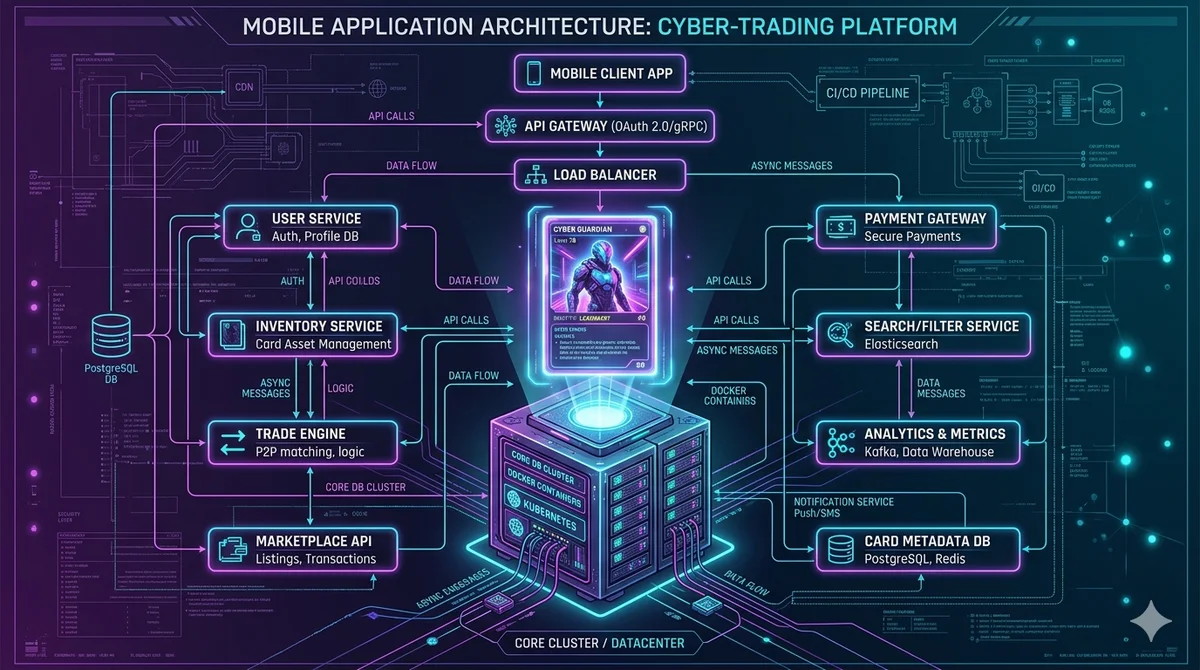
💻 ARCHITECTURE DEEP-DIVE: Building a modern Pokémon TCG collection app requires more than just fetching images. It requires robust architecture to handle real-time pricing grids, user portfolios, and instant card scanner apps. In this guide, we dive into the infrastructure that powers top-tier applications.
Quick Answer: The ideal Pokémon TCG app architecture separates the frontend client, a unified backend, and a specialized TCG API integration layer. By using dedicated services like the PokéWallet API, developers can bypass the complexity of merging disparate data sources (TCGPlayer, CardMarket) and focus directly on Pokémon collection app development. Key components include Redis caching layers, webhook updates for price fluctuations, and optimized OCR/computer vision models for card scanning.
When developers set out to build a Pokémon collection app in 2026, they quickly encounter the reality of the secondary market: data is fragmented, messy, and hard to normalize. A standard card from an older set has multiple variants (Reverse Holofoil, 1st Edition, Unlimited) and wildly fluctuating market prices across different regional platforms.
This technical architecture guide will show you how Pokémon TCG APIs effectively solve these challenges. We will outline the optimal tech stack, discuss best practices for backend engineering, and break down the integration strategies required to create applications that can scale to hundreds of thousands of concurrent users.
The Core Pokémon TCG App Architecture
Building a resilient architecture means anticipating traffic spikes during major new set releases (such as the recent Ascended Heroes block) and managing millions of data points effectively without incurring crushing infrastructure costs.
High-Level System Design
A robust system uses a microservices or modular monolith approach, generally divided into three major horizontal layers:
- Client Layer (Mobile/Web): Built with progressive frameworks like React Native, Flutter, Swift/Kotlin (for native), or Next.js. This layer handles user portfolio visualizations, state management, and device-level tasks like camera access for a Pokémon card scanner app.
- Application Backend: NodeJS, Go, or Python FastAPI. This acts as the orchestration layer, responsible for user authentication, portfolio state mutation, localized math (portfolio total calculation), and handling caching.
- External API/Data Layer: This is where the magic happens. Instead of building web scrapers, modern apps rely on a unified third-party data layer for market values and localized strings.
graph TD;
    Client[Client Application Mobile/Web - React Native] --> API_Gateway[API Gateway / Load Balancer];
    API_Gateway --> Auth[Authentication Service];
    API_Gateway --> Portfolio[Portfolio Management Service];
    API_Gateway --> Scanner[Card Scanner / OCR Service];
    Portfolio --> Cache[(Redis Distributed Cache)];
    Portfolio --> DB[(Primary PostgreSQL DB)];
    Portfolio --> ExternalAPI[External TCG APIs];
    Scanner --> ExternalAPI;
Database Schema Design
For Pokémon collection app development, relational databases (like PostgreSQL) are highly recommended. A typical collection is inherently relational (A user has many binders, a binder has many slots, a slot belongs to a card ID).
Key schema optimizations:
users: Lightweight profiles storing auth parameters.portfolios: Aggregate level statistics to avoid recounting hundreds of rows on page load.portfolio_items: Individual tracked instances. Instead of duplicating string data, link to the overarching globalcard_idprovided by your API, and only store user-specific conditions (e.g., PSA Grade 10, Near Mint, purchase price).
Implementing a Pokémon Card Scanner App
One of the most heavily requested features for any companion tool is scanning. Building a functional Pokémon card scanner app requires a highly optimized data pipeline to ensure users get immediate results.
1. Image Capture and Pre-Processing
The client application captures the image using native device bindings. Edge detection algorithms are run locally on the client's device to crop the core card rectangle from background noise (like tables or binder pages). The image is then compressed—typically under 500KB—and converted to grayscale if color metrics are not required, saving significant bandwidth.
2. OCR and Feature Extraction
The backend receives the compressed payload and processes it via Optical Character Recognition (OCR) or a lightweight machine learning vision model. The engine specifically isolates regions of interest:
- Set Symbols / ID: Usually at the bottom left or right.
- Card Number: e.g., "004/165".
- Name & HP Blocks: To verify exact variants.
3. API Triangulation
Once text parameters are successfully parsed, the backend formulates a hyper-specific query to the TCG API.
For example: GET /cards/search?name=Charizard&number=004/165 ensuring a near-instant 99% match rate. The full object, containing price and high-resolution art, is returned to the user in less than 300ms.
Pokémon API Best Practices for TCG Developers
To ensure high performance and low latency, developers must adhere to strict Pokémon API best practices when integrating external market data.
1. Enforce Aggressive Caching
Pricing data moves fast, but not millisecond-by-millisecond fast. Set up a Redis caching layer for your proxy routes:
- Static Card Data (Names, Types, Abilities): Cache indefinitely or update just once a month.
- Market Prices: Cache aggregations for 15-60 minutes depending on your application's tier. This dramatically reduces API consumption.
2. Implement Fallbacks and Retry Logic
All external systems can experience turbulence. Employ exponential backoff protocols. If a TCG API request times out, log the error but gracefully serve the last known cached snapshot to the user with a subtle UI indicator marking the data as "Cached".
3. Batch Your Downstream API Requests
If a user signs in and views a portfolio of 500 loaded cards, do not execute an O(n) loop of 500 separate API calls. Top-tier providers offer bulk endpoints. See our tutorial on how to Build a Price Tracker for a deep dive into minimizing request bloat.
TCG API Integration: Traditional vs. Modern Approaches
Choosing the correct downstream data pipeline defines your operational expenditure. Here is a technical comparison outlining the stark differences in TCG API integration methods.
| Architecture Component | Traditional (DIY / Web Scraping) | Modern Approach (e.g., PokéWallet API) |
|---|---|---|
| Data Normalization | Requires maintaining complex regex maps connecting "Snorlax VMAX" to "Snorlax-VMAX Secret Rare". | 100% unified naming schemas and enumerated variants directly from the endpoint. |
| Market Coverage | Requires deploying separate scraper clusters for TCGPlayer, CardMarket, and eBay. | Aggregated global prices delivered in a single unified JSON payload. |
| Asset Delivery | Hosting gigabytes of images on custom S3 buckets, incurring huge egress fees. | Lightning-fast CDN-delivered compressed webp art accessible directly via API URL structures. |
| Maintenance | Brittle HTML DOM parsing that breaks whenever a marketplace updates its UI. | Stable, version-controlled JSON structure with SLAs and SLA-backed uptime. |
Frequently Asked Questions
What is the best language to build a Pokémon collection app?
JavaScript/TypeScript (via Node.js/Next.js) is wildly popular due to its native handling of nested JSON responses from TCG APIs. Alternatively, Python is exceptional if you are doing extensive data science workflows or building your own computer vision ML models for card scanning logic.
How do I handle missing card data from an API?
Always build elegant polymorphic fallback UI states. If an API returns a null price payload due to a lack of market data (which frequently occurs for ultra-rare vintage or low-population grading brackets), display a "Market Data Unavailable" banner rather than allowing your portfolio summation math to throw a NaN error.
Can I build a scanner app without custom AI models?
Yes you can. As a straightforward alternative, you can use standard off-the-shelf OCR libraries (like Cloud Vision API or Tesseract.js) to extract the text string of the card name and set number, then pass those deterministic queries to your TCG API to find the exact match without maintaining expensive custom vision models.
Conclusion
Understanding correct Pokémon TCG app architecture makes the difference between a sluggish, expensive hobby project and a professional-grade platform ready to handle hundreds of thousands of monthly active users.
By leveraging well-organized relational database schemas, implementing robust caching for optimal Pokémon API best practices, and utilizing modern, unified external endpoints, developers can launch highly functional Pokémon collection apps with a fraction of the technical overhead.
Start engineering the future of the TCG hobby today:
- 📚 Read our comprehensive API Usability Guide
- 🛠️ Learn how PokéWallet API is a game changer for developers
- 🚀 Register for Free Developer API Access
Built by software engineers and collectors, empowering developers to build the next generation of TCG tools.