30 Years of Pokémon: The Cards That Defined the Market (1996–2026)
From Base Set Charizard to the Mega Evolution era, these are the Pokémon cards that shaped the collecting market across three decades — and what each one teaches collectors and investors heading into the 30th anniversary.
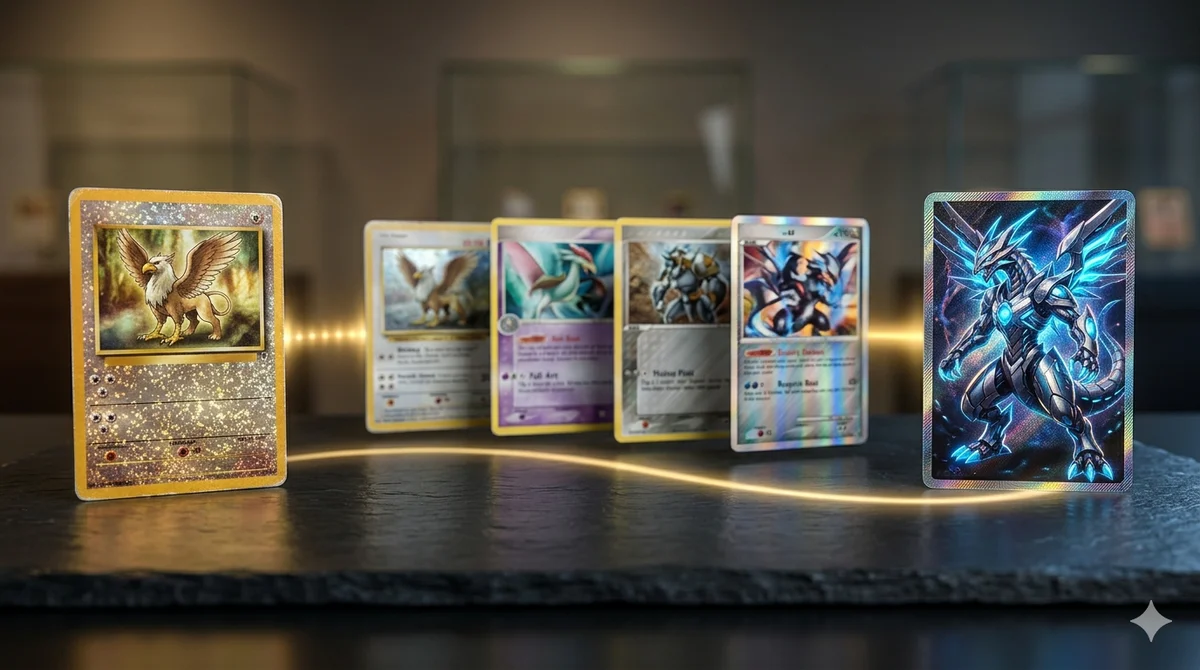
30 Years of Pokémon: The Cards That Defined the Market
🎂 30TH ANNIVERSARY: The Pokémon TCG turns 30 in 2026, and the 30th Celebration set is built entirely on this history — 30 Classic Collection reprints spanning the game's whole timeline. This is the perfect moment to look back at the cards that didn't just sell, but defined how the market thinks.
Quick Answer: Across 30 years, a handful of cards repeatedly defined what the Pokémon market values: Base Set Charizard (1999) set the template for the chase card; the Pikachu Illustrator (1998) became the ceiling for ultra-rarity; Gold Star cards (2004–07) proved special treatments drive premiums; Hidden Fates and Celebrations showed how reprint/anniversary sets create durable demand; and the Mega Evolution era (2025–26) showed how nostalgia mechanics revive a whole market. The throughline: scarcity + nostalgia + an iconic Pokémon = lasting value.
The Pokémon TCG turns 30 in 2026, and the 30th Celebration set is built entirely on this history. So it's the perfect moment to look back at the cards that didn't just sell, but defined how the market thinks. Each one taught collectors a lesson that still drives prices today — and each maps directly onto how you should approach the anniversary year.
Key Takeaways
- 🔥 Base Set Charizard (1999): The original chase card — the template every modern set still chases.
- 🎨 Pikachu Illustrator (1998): The ultra-rarity ceiling; proof that provenance and scarcity have no real cap.
- ⭐ Gold Star era (2004–07): Special treatments, not just rarity tiers, became value drivers.
- 📦 Hidden Fates / Celebrations: Anniversary and reprint sets create durable, appreciating sealed demand.
- 🧬 Mega Evolution era (2025–26): Nostalgia mechanics can revive an entire collecting cycle.
- 🧭 The lesson: Scarcity + nostalgia + an iconic Pokémon is the formula that has held for three decades.
⚡ Quick Navigation
1996–1999: The Foundation
📌 TL;DR: The first sets established the chase-card concept and minted the two cards that still define the ceiling and the floor of vintage value.
The TCG launched in Japan in October 1996. The Western Base Set followed in 1999, and with it came the card that is Pokémon collecting to most people.
Base Set Charizard (1999)
Holo Charizard became the playground holy grail and remains the benchmark vintage chase card. High-grade copies are blue-chip collectibles whose value has been remarkably durable across decades of market cycles. Lesson: an iconic Pokémon + first-print scarcity = the most durable demand in the hobby. Every modern flagship chase card — right up to the 30th Celebration's Classic Collection Charizard reprint — is chasing the template Base Set Charizard set.
Pikachu Illustrator (1998)
Awarded through illustration contests, with only a tiny number in existence, it set the all-time ceiling for Pokémon card value. Lesson: extreme scarcity plus provenance creates a market with no practical cap. It's the proof-of-concept that, for the right card, demand has no upper bound.
2004–2007: Treatments Become Value
📌 TL;DR: Gold Star cards proved that a special finish — not just a rarity slot — could command a premium. It's the direct ancestor of every modern alt-art and the new Futuristic Rare.
The Gold Star cards of the EX era introduced shiny-variant Pokémon with a distinctive gold star and unique foil treatment. They were the first widely chased "special treatment" cards, and high-grade examples remain genuinely valuable today.
This is the direct lineage of the modern market. Special Illustration Rares, Hyper Rares, the Mega Attack Rare, and the brand-new Futuristic Rare all descend from the lesson Gold Stars taught:
- Collectors will pay for how a card looks, not just how rare its slot is.
- A distinctive, recognizable treatment creates demand independent of playability.
- The first of a new treatment carries a premium later printings rarely match.
Lesson: aesthetics are an asset class of their own — which is exactly why a brand-new rarity like the Futuristic Rare is such a closely watched event.
2016–2021: The Anniversary Playbook
📌 TL;DR: Hidden Fates and Celebrations proved that reprint/anniversary sets create some of the most durable sealed-product demand in the hobby.
Two sets rewrote the rules for sealed product.
Hidden Fates (2019)
A special set with a shiny vault that became famous for sealed product that kept appreciating well after release — a rarity in a hobby where most sealed product depreciates first. Lesson: a special set with a strong hook can break the normal depreciation curve.
Celebrations (2021) — the 25th anniversary
This is the exact blueprint the 30th Celebration expands on:
- Featured a Classic Collection of 25 reprints (Base Set Charizard included)
- Never meaningfully dropped below MSRP on sealed product
- Elite Trainer Boxes and Booster Bundles appreciated steadily as supply dried up
Lesson: anniversary sets are limited-window prints with permanent nostalgia demand — and the market rewards holding them. The 30th Celebration takes this playbook and scales it: 30 reprints instead of 25, an all-foil print run, a guaranteed Pikachu per pack, and the new Futuristic Rare. For how to buy it, see our 30th Celebration pre-order guide.
2025–2026: The Mega Evolution Revival
📌 TL;DR: The Mega Evolution era turned a beloved old mechanic into the most collected cycle in years, proving nostalgia can revive an entire market segment.
Inspired by Pokémon Legends: Z-A, the Mega Evolution era brought back Gen VI's signature mechanic and reignited collector enthusiasm. Sets like Ascended Heroes, Perfect Order, and Chaos Rising reintroduced Mega Pokémon ex and the retro-styled Mega Attack Rare, while Pitch Black Night (July 2026) leans into fan-favorite Megas like Darkrai.
What the era proved:
- A mechanic with built-in nostalgia can carry an entire cycle of demand.
- Attaching that mechanic to iconic Pokémon is what separates winners from filler.
- Modern sets can generate vintage-style enthusiasm when the emotional hook is right.
Lesson: nostalgia isn't only a vintage phenomenon — it's a repeatable demand engine, and it's exactly the energy the 30th Celebration is engineered to capture. For a data-driven look at how the era's individual sets performed, see our Mega Evolution era recap.
What 30 Years Teaches Collectors
📌 TL;DR: The cards that defined the market all share three traits. Use them as a filter for what to buy heading into the anniversary.
The pattern across three decades is remarkably consistent. The cards that defined the market share:
- An iconic Pokémon (Charizard, Pikachu, Mewtwo, Mew).
- Genuine scarcity (first prints, limited windows, low pull rates).
- A nostalgia hook (a moment, an anniversary, a revived mechanic).
| Era | Defining Card(s) | The Lesson |
|---|---|---|
| 1996–1999 | Base Set Charizard, Pikachu Illustrator | Icon + scarcity = durable demand |
| 2004–2007 | Gold Star cards | Treatments are their own value |
| 2016–2021 | Hidden Fates, Celebrations | Anniversary/reprint sets hold |
| 2025–2026 | Mega Evolution era | Nostalgia mechanics revive markets |
That filter is exactly how to approach the 30th Celebration: the Classic Collection reprints hit nostalgia + iconic Pokémon, and the Futuristic Rares add scarcity and a guest-artist hook. It's the three-decade formula, packaged for the anniversary.
💡 PokéWallet tip: Build a "history" watchlist of the cards above and track how vintage and modern move differently over the anniversary year. See it in your PokéWallet portfolio.
What the Next 30 Years Might Reward
📌 TL;DR: The same three traits — icon, scarcity, nostalgia — will keep defining value. The newest expression of the formula is the 30th Celebration's Futuristic Rare: marquee Pokémon, a limited window, and a brand-new rarity.
History rhymes. The cards likely to define the next stretch of the market will share the same DNA as the last three decades — and several candidates are already visible:
- The Futuristic Rare Mewtwo ex & Mew ex — marquee Pokémon, a limited-window anniversary set, a guest artist, and a brand-new rarity with no supply precedent. It's the three-decade formula in modern form. (See our Futuristic Rare deep-dive.)
- Limited-window anniversary sealed — if Celebrations (2021) is the guide, the 30th Celebration's sealed product is a natural long-hold candidate.
- Era-defining "first" cards — the inaugural cards of new mechanics and eras (as the Mega Evolution era showed) tend to accrue outsized attention over time.
The constant
What won't change is the filter. Whatever the next decade's headline card turns out to be, it will almost certainly be an iconic Pokémon, genuinely scarce, with a nostalgia or novelty hook. Buy through that lens and you're buying the pattern that has held since 1996.
Frequently Asked Questions
What is the most important Pokémon card ever?
Base Set Charizard (1999) is the cultural and market benchmark — the card most people picture when they think "valuable Pokémon card." The Pikachu Illustrator (1998) is the value ceiling, with only a handful in existence.
Why do anniversary sets hold value?
They're printed for a limited window and carry permanent nostalgia demand. Celebrations (2021) is the clearest example — sealed product never meaningfully dropped below MSRP — and the 30th Celebration follows the same playbook on a larger scale.
Are vintage cards a better investment than modern?
They behave differently — vintage is scarcer and steadier, modern is more liquid and volatile. The cards that last share scarcity, nostalgia, and an iconic Pokémon regardless of era. A balanced collection often holds both.
What makes the Mega Evolution era significant?
It proved that a nostalgia-driven mechanic, attached to iconic Pokémon, can power an entire collecting cycle — bringing vintage-style enthusiasm to modern sets and setting up the 30th-anniversary year.
How do I use this history to buy smart in 2026?
Filter purchases through the three-decade formula: iconic Pokémon, genuine scarcity, and a nostalgia hook. The 30th Celebration set hits all three, which is why it's the year's marquee opportunity.
Track 30 Years of Prices with PokéWallet
From vintage Base Set holos to the brand-new Futuristic Rare, PokéWallet lets you track the cards that defined the market — and the ones defining it now.
- 🔔 Price alerts — get notified when any card on your watchlist hits your target
- 📊 Live prices from TCGPlayer & CardMarket across vintage and modern
- 📈 Historical charts — compare how different eras move over time
- 💰 Portfolio tracking — monitor your whole collection's value in one place
- 💬 Live community discussion in our Discord
Stay Ready:
- 🚀 Start Free — No credit card required
- 📝 Read more Pokémon TCG news, market analysis, and investment guides
- 📱 Follow @pokewallet.io for daily market coverage
This article is for informational purposes only and is not financial advice. Card prices are volatile and historical performance does not guarantee future results. Always verify current pricing before purchasing.